

Camp Lejeune: How World War II Built the Marine Corps' East Coast Home
A County Goes to War
Before 1941, Onslow County was a quiet, rural area of roughly 17,000 people. Farming, fishing, and timber were the economic pillars. That all changed in a matter of months when the United States Marine Corps selected the county as the site for a massive new amphibious training base.
Why Onslow County?
The Marines needed a base with specific characteristics: a long coastline for amphibious landing exercises, large tracts of undeveloped land for maneuver training, a temperate climate allowing year-round operations, and proximity to deep-water ports. Onslow County, with its 14 miles of coastline, vast pine forests, and relatively sparse population, checked every box. The New River provided additional training waterways.
The Great Displacement
The establishment of Camp Lejeune required the acquisition of over 111,000 acres — roughly 174 square miles of Onslow County. Entire communities were displaced. The villages of Montford Point, Courthouse Bay, and several other small settlements were absorbed into the base. Families who had lived on the land for generations received government buyouts and were forced to relocate, many with only weeks' notice. It was a wrenching transformation, carried out with the urgency of a nation preparing for global war.
Named for a Legend
The base was named after Lieutenant General John Archer Lejeune, the 13th Commandant of the Marine Corps and a legendary leader who served in the Spanish-American War, the Philippine-American War, and World War I. Lejeune was born in Pointe Coupee Parish, Louisiana, and was widely regarded as one of the greatest Marine Corps leaders in history.
Wartime Expansion
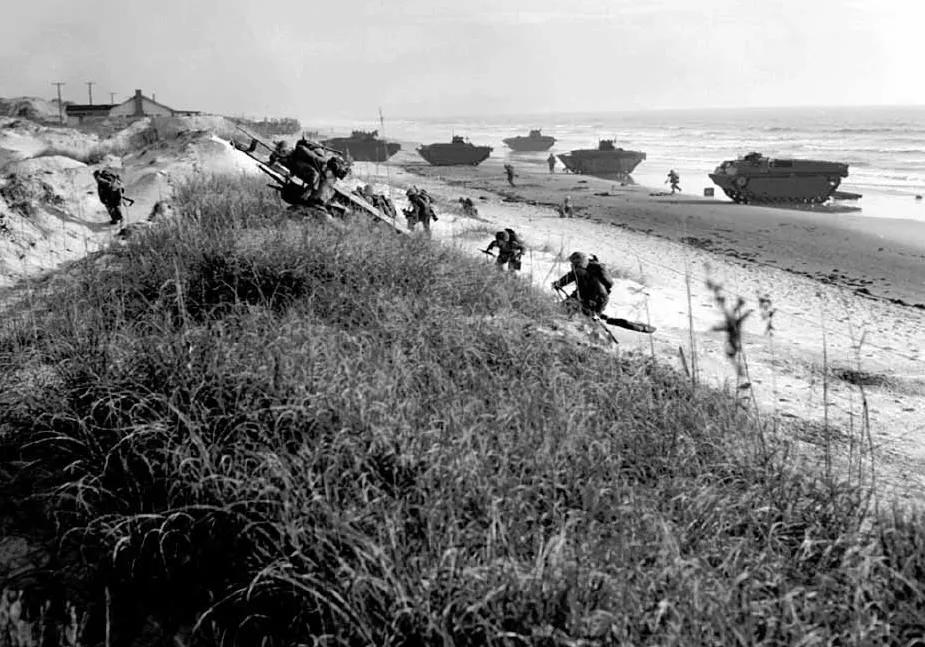
Construction moved at a breakneck pace. By 1942, thousands of Marines were training at Camp Lejeune for the Pacific island-hopping campaigns that would prove decisive in World War II. The base included rifle ranges, obstacle courses, mock villages for urban warfare training, and miles of beach for practice landings. At its peak during WWII, the base housed over 100,000 Marines and sailors.
Montford Point Marines
Camp Lejeune holds a significant place in civil rights history. In 1942, the first African American Marine recruits were sent to Montford Point, a segregated facility within the base. The approximately 20,000 Montford Point Marines who trained there between 1942 and 1949 endured discrimination but served with distinction. In 2012, the surviving Montford Point Marines were collectively awarded the Congressional Gold Medal — the highest civilian honor Congress can bestow.
A Permanent Presence
After the war, Camp Lejeune became a permanent installation rather than being decommissioned. The Korean War, Vietnam War, and subsequent conflicts ensured the base continued to grow. Today, Marine Corps Base Camp Lejeune is the home of the II Marine Expeditionary Force and one of the largest Marine Corps installations in the world, supporting approximately 47,000 military personnel and 170,000 dependents, retirees, and civilian employees.